
One of the biggest misconceptions in legal AI is that the goal is to find the best model.
The more important question is what happens when models disagree.
We recently evaluated a small document set using three foundation models, repeated sampling and adversarial challenge testing. The run produced 108 results across four documents and three prompts.
The objective was not to declare one model the winner. It was to understand how reliable each finding was before anyone relied on it in a legal or compliance workflow.
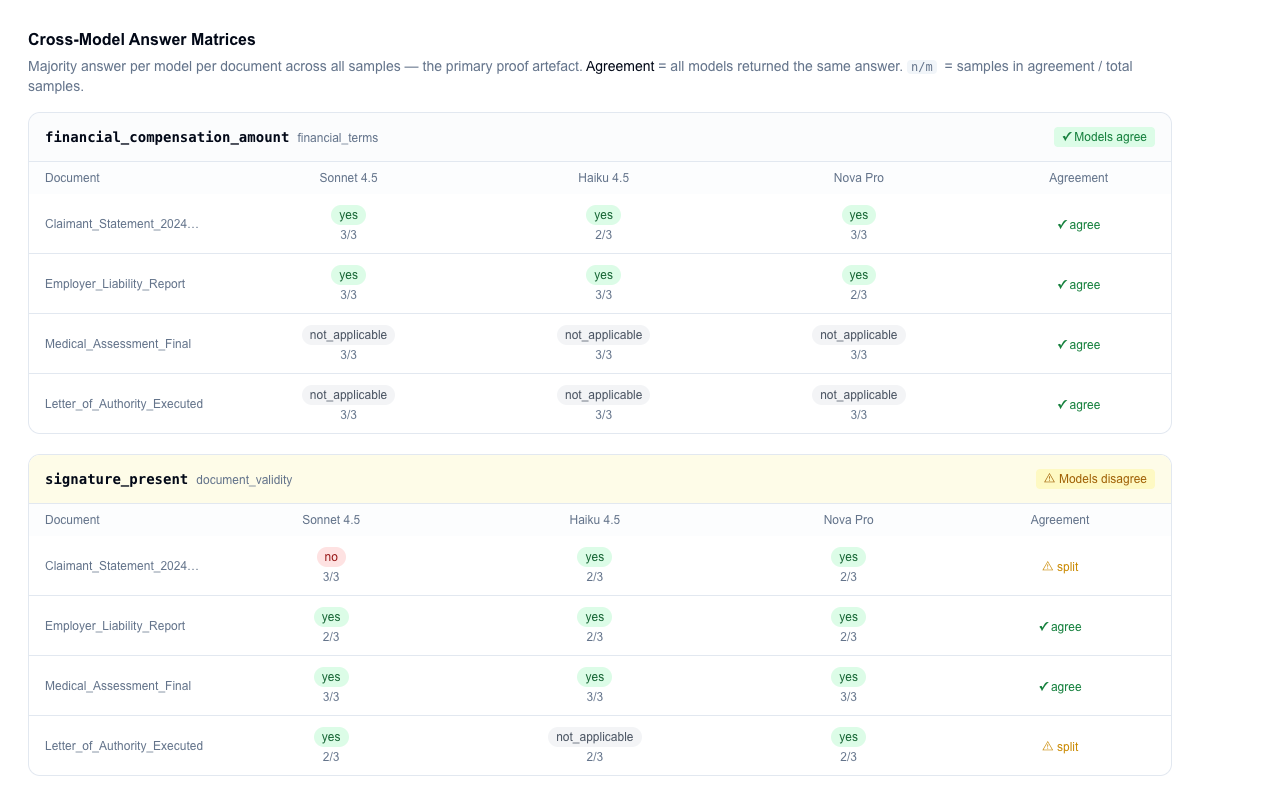
Across four evaluation iterations, the overall assurance measure increased from 75% to 93%. Evidence support increased from 74% to 96%. That improvement did not come from changing the question to "which model is best?" It came from improving prompts, evidence extraction and the evaluation process.
Agreement is useful, but it is not the whole answer
Some findings produced clear agreement.
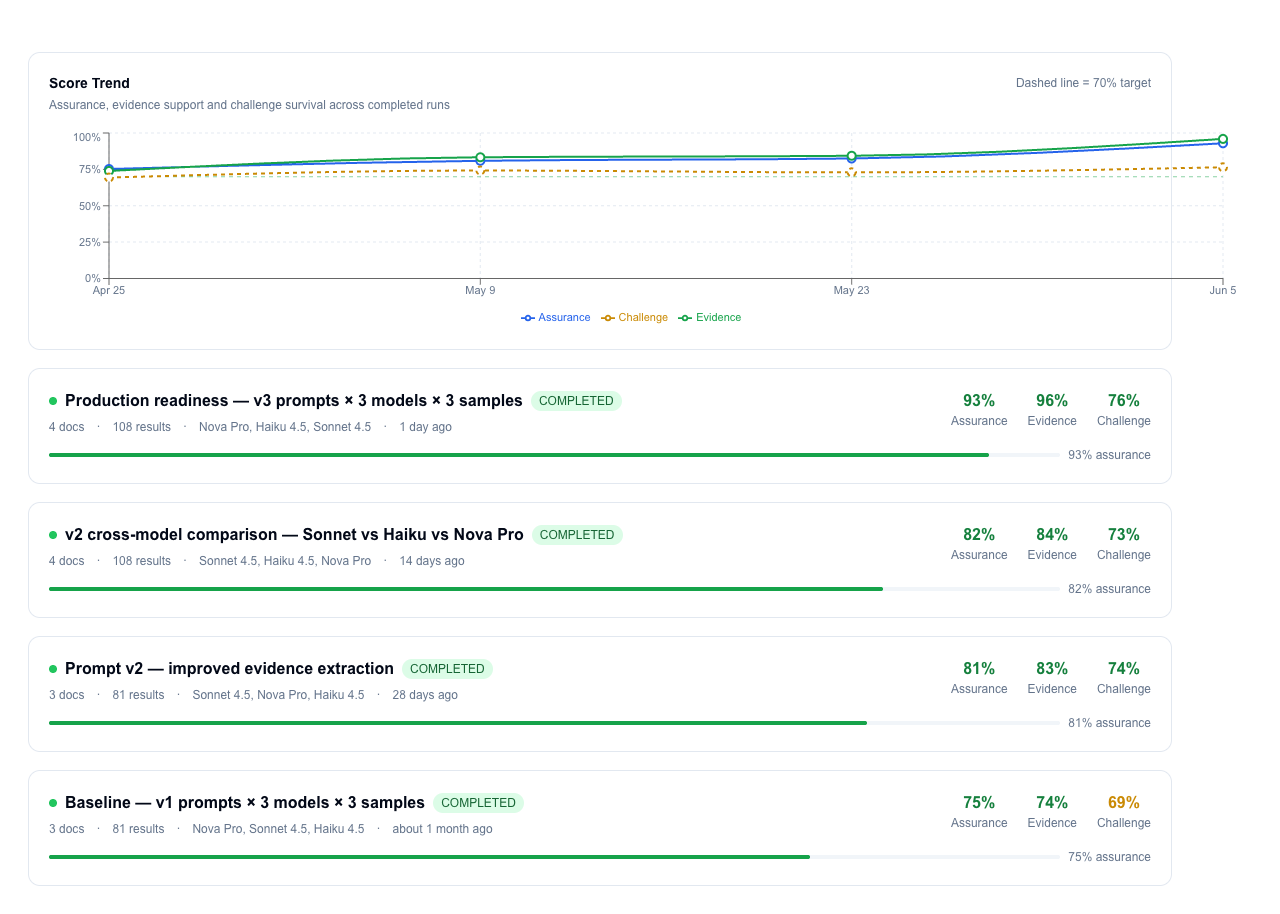
For financial compensation, all three models reached the same majority answer on every document. On two documents they identified a value. On the other two they agreed the question was not applicable.
That agreement matters. So does consistency across repeated samples. A majority answer backed by three identical runs is stronger than the same answer produced in only two out of three runs.
This creates two separate questions:
- do different models reach the same conclusion?
- does each model reach the same conclusion when asked again?
Both are observable. Neither requires accepting a model's own confidence score.
Disagreement reveals interpretation risk
The more valuable results came from disagreement.
On one document, the models assessed whether a claimant signature was present. One model returned no in all three samples. The other two returned yes as their majority answer, but each produced that answer in only two of three samples.
This finding contained two risks at once. The models interpreted the same document differently and two models were not fully stable across repeated runs.
The termination-clause results showed another pattern. On one medical assessment, two models returned yes while the third returned unclear. On other documents, all three agreed.
The disagreement was not simply random noise. It showed where document context, prompt interpretation or evidence handling needed investigation.
Many organisations monitor whether one model changes its answer. Equal attention should be paid to whether different models interpret the same evidence differently.
That is often where operational risk sits.
Disagreement and instability are different problems
Cross-model disagreement and sampling instability should not be collapsed into one score.
A model can be perfectly stable and consistently disagree with its peers. That points towards an interpretation difference.
Models can also agree on the majority answer while one model changes its response across repeated samples. That points towards instability.
The response should be different in each case. Interpretation risk may require prompt refinement, closer evidence review or a clarified policy. Instability may require more sampling, a narrower task or a deterministic rule.
A single confidence percentage does not explain which problem exists.
The operational constraint behind sampling
Imagine asking twenty experienced professionals to review the same document.
With enough time, clear instructions and no external pressure, the results may be highly consistent. Real organisations do not operate under those conditions. Teams face deadlines, budgets, competing priorities and variable capacity.
That is why legal and compliance teams use sampling. Reviewing every file, claim or document can be impractical, so a smaller population is reviewed and the findings are extrapolated.
Sampling is a rational response to operational constraints. It also means accepting that much of the population remains unseen.
AI creates the opportunity to assess a far larger share of the population and direct professional judgement towards the findings that genuinely need attention.
That does not remove the need for validation. It increases it.
From confidence scores to assurance metrics
Most AI systems present a confidence score generated by the model itself.
A model can be highly confident and still be wrong. Assurance should therefore be built from observable characteristics:
- is the finding linked to supporting evidence?
- do multiple models agree?
- does the answer remain stable across repeated samples?
- does it survive contradiction or alternative interpretation?
- can the result be reproduced?
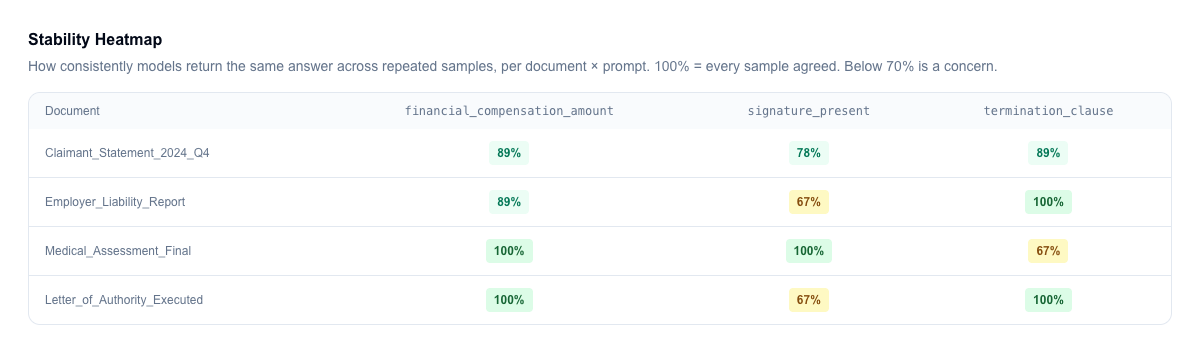
The stability heatmap from the evaluation makes the distinction visible. Some document and prompt combinations produced the same answer in every sample. Others reached only 67% stability.
These measures are not substitutes for professional judgement. They help determine where that judgement should be applied.
They can also be recorded, compared and audited.
An assurance framework for legal AI
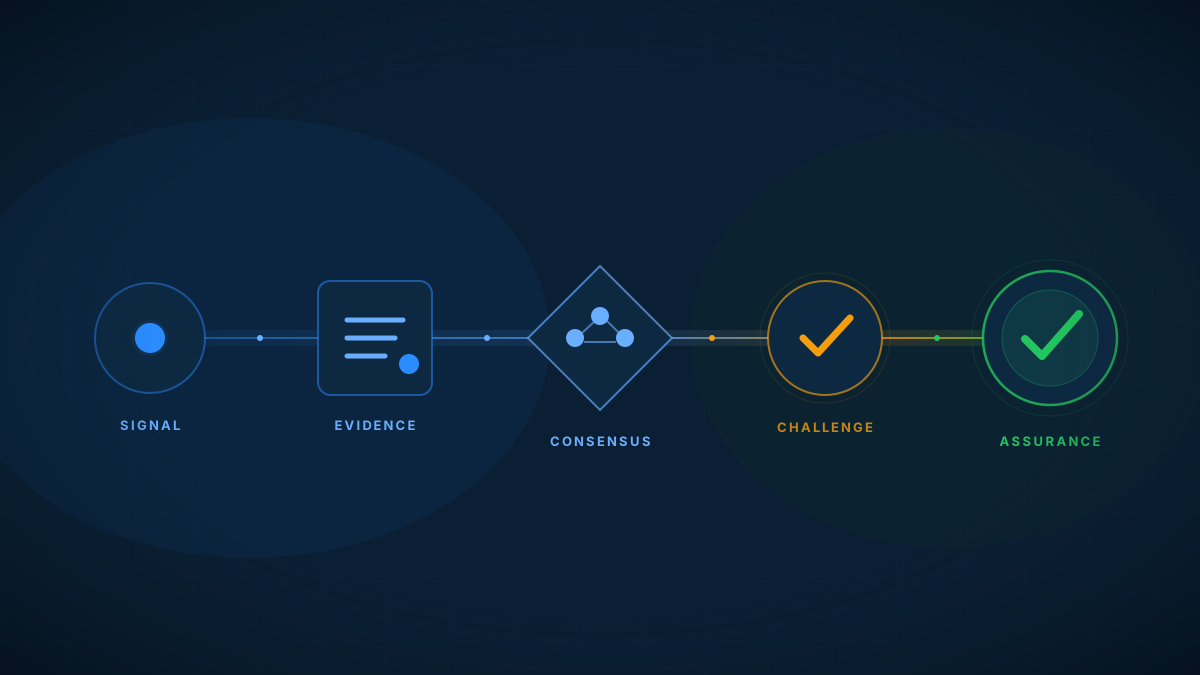
At Lexivoa, we are developing an approach built around five connected stages:
- Signal: identify a potential finding
- Evidence: link it directly to source material
- Consensus: measure agreement across models
- Challenge: test contradiction and alternative interpretation
- Assurance: present the result with its supporting measures and limitations
Under this approach, the most valuable output is not a confidence percentage.
It is an evidence-backed explanation of what was found, why it was found, where disagreement exists and whether human review is required.
Expanding oversight without removing judgement
The objective is not to replace professional judgement. It is to extend visibility.
Instead of reviewing 5% or 10% of a population, organisations can begin to assess every available document or record, then focus human expertise on exceptions, conflicts and weak evidence.
That shift changes the role of AI. It stops being an answer engine and becomes part of a governed review process.
Legal teams have faced a similar adoption challenge before. Technology Assisted Review was not accepted because lawyers suddenly trusted machines. It was accepted because methodologies emerged that allowed results to be measured, tested and defended.
Generative AI faces the same hurdle.
The organisations that extract the most value from legal AI will not simply have access to the latest model. They will have the strongest processes for evaluating, validating and governing AI-generated findings.
The question is not only what the AI said.
The question is why anyone should trust it.
Lexivoa Mandate
Build assurance into every AI-assisted finding
Lexivoa Assurance links findings to evidence, preserves review history and keeps human judgement inside a controlled audit workflow.
Explore Lexivoa Assurance