
Gian Kull of Legal Asset Servicing made an observation this week worth paying attention to.
Claude for Legal may help lawyers automate work. But it exposes something the sector has been slow to name: funders don't have systems that convert case activity, invoices, approvals and docket events into signals they can act on.
The problem runs deeper than which AI tool you use.
Garbage in, garbage out
Most litigation finance workflows are still manual. Audits are run on whatever data the law firm provides. Results are written up. Someone reviews them. Action happens later.
Apply AI to that workflow and you get faster summaries of unreliable inputs. The output is only as good as what went in — and what goes in is usually inconsistent, unstructured and impossible to compare case to case.
That is not a model problem. It is a data problem. And it sits one layer below where most of the industry is looking.
Three signals from this week
The LAS piece landed alongside three other developments that point the same direction.
The PACCAR fix was absent from the King's Speech. Litigation funding agreements remain in a regulatory grey zone for another cycle. What funders can prove about their portfolios now carries more weight than what they can claim.
Hedge funds are buying distressed legal assets — sometimes at 10 cents on the dollar. New capital entering at that discount needs to understand what it is acquiring. That is a diligence and visibility problem, not a legal one.
CAT scrutiny on opt-out collective actions is tightening. Funder returns, funding arrangements and class representative independence are all in scope. Michigan passed reforms requiring funder disclosure and registration. The direction is consistent.
Every one of these increases the cost of not knowing what is happening inside a portfolio.
The execution layer matters
What actually changes the risk profile is not better AI. It is where the data comes from in the first place.
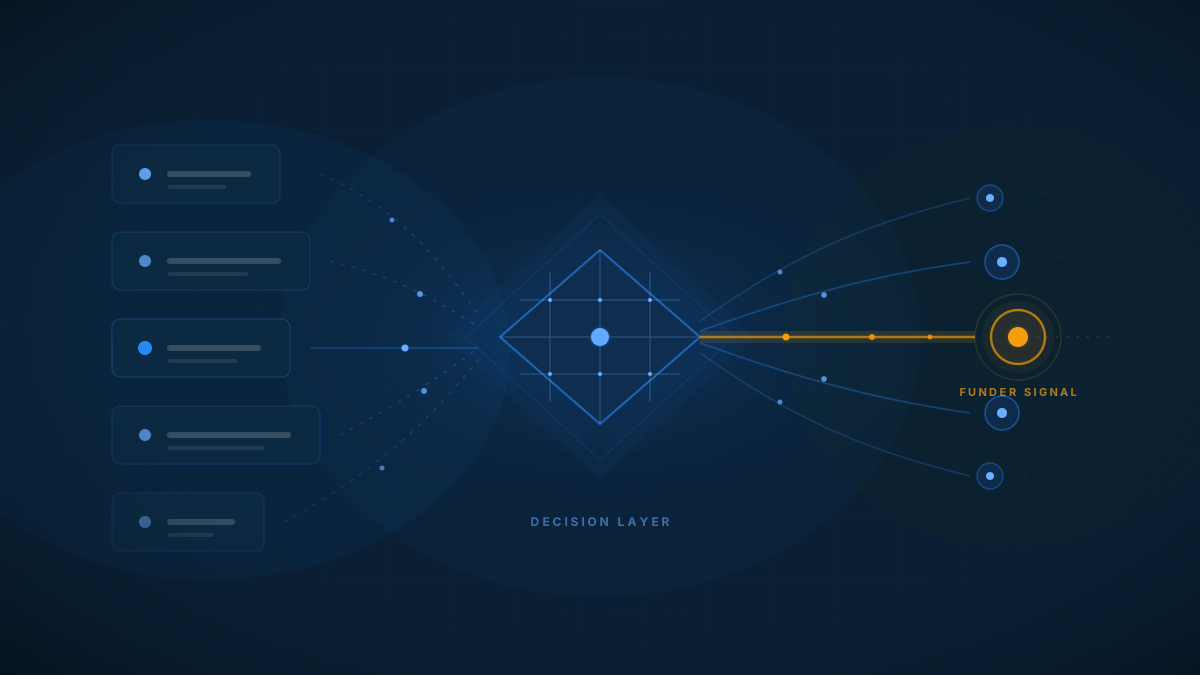
If the audit is performed inside a purpose-built system — against a predefined mandate, with consistent structure across every case — then the output is already a signal. Something that can be tracked over time, compared across a portfolio, and acted on without a manual review cycle in the middle.
That is why Lexivoa built both sides.
Assurance is the execution layer — the application auditors actually work in. Cases are assessed against mandates in a structured environment, so what comes out is clean, consistent and auditable from the source, not cleaned up after the fact.
The funder layer sits on top of that. Because the data underneath is structured, the signals reaching funders are reliable. Not AI processing someone's spreadsheet. Structured outputs from the moment the audit work happens.
See how cases move through Assurance →
Where this is heading
The LAS observation will read differently depending on who picks it up. For lawyers, Claude for Legal is a productivity tool. For funders, it is a prompt to ask a harder question: where does the data come from, and how clean is it before any AI touches it?
The market this week gave three reasons why that question is becoming urgent.
Decision infrastructure without a reliable execution layer is just faster noise.