
Litigation funders have become increasingly sophisticated in the way they assess opportunities, govern capital and monitor investments.
Underwriting frameworks are more structured. Portfolio oversight is more disciplined. Reporting expectations continue to rise.
But the experience surrounding those processes has not always evolved at the same pace.
For many law firms and limited partners, interacting with a funder can still involve a fragmented sequence of emails, spreadsheets, document requests, reminders and status updates. Each interaction may be necessary, but the overall journey is rarely designed as one connected experience.
That matters because operational excellence is not only about how a funder makes decisions. It is also about how clearly, consistently and confidently other people are brought through them.
For funders, this makes stakeholder experience part of litigation funding governance rather than a separate service initiative.
CX means more than customer service
Customer experience—or, more appropriately in this context, stakeholder experience—is sometimes treated as a matter of responsiveness, presentation or relationship management.
Those things are important, but they are only part of the picture.
A well-designed experience answers a more practical set of questions:
- Does each participant understand what is required from them?
- Is information collected once and reused appropriately?
- Are requests, reminders and decisions communicated consistently?
- Can someone see what has happened, what is outstanding and what comes next?
- Are important communications connected to the relevant matter, firm, fund or relationship?
- Can the funder demonstrate how the process was followed?
In this sense, CX is a form of operating design. It is the way processes, communications, controls and human interactions are assembled into a coherent journey.
Law firms and LPs require different journeys
There is no single funder experience.
A law firm approaching a funder has different objectives, pressures and information needs from an LP monitoring an investment relationship. Both journeys may pass through the same organisation, but they should not be designed in the same way.
For a law firm, the journey might include:
- initial eligibility and onboarding
- conflict, compliance and relationship checks
- matter information and document collection
- requests for additional evidence
- funding assessment and approval updates
- ongoing reporting obligations
- changes to the matter or legal team
- periodic relationship reviews
The quality of that experience often depends on clarity. The firm needs to know what information is required, why it is required, who is responsible and what will happen next.
For LPs, the journey may include:
- relationship and account onboarding
- due-diligence information
- reporting preferences
- access to portfolio and performance information
- capital-call and distribution communications
- governance, exception and risk reporting
- requests for additional information
- periodic review meetings and follow-up actions
Here, confidence and consistency are especially important. LPs need timely information, but they also need assurance that communications, reporting and decisions are governed appropriately.
The relationship manager remains central to both experiences. The opportunity is to give that person a better operating environment—not to automate the relationship away.
A portal is not the same as a journey
Digital portals can improve access to documents and information. However, providing a portal does not necessarily create a coherent experience.
The real journey often extends across forms, emails, messages, documents, tasks, reviews, approvals, reminders, meetings, decisions and record updates.
If these interactions are disconnected, participants still experience the underlying fragmentation—even when some of them happen through a polished interface.
Designing the journey means connecting these interactions around a shared process. A submitted form should inform the relevant record. Missing information should create a clear request. A completed review should move the process forward. A decision should be communicated and recorded. An overdue action should be visible before it becomes a problem.
The interface is important, but orchestration is what makes the experience coherent.
Poor journeys create cost and risk
A fragmented experience is not merely inconvenient for the participant. It also creates cost and risk inside the funder.
When journeys depend on disconnected emails, spreadsheets and individual memory, internal teams spend more time:
- chasing missing information
- re-entering data
- clarifying ambiguous requests
- searching for correspondence
- checking whether actions were completed
- reconstructing the basis of previous decisions
- correcting inconsistent records
- manually preparing routine updates
These activities may appear individually minor, but they compound across every law-firm relationship, matter and LP account.
Fragmentation can also create operational risk. A request may be sent to the wrong person. An important response may remain in an individual inbox. A control may be completed but not recorded. Two teams may act on different versions of the same information. A missed handoff may delay a decision or leave an obligation outstanding.
Poor experience is therefore often a symptom of poor process visibility.
Conversely, a well-designed journey can reduce unnecessary contact, improve the quality of information received and create a more reliable record of requests, responses, actions and decisions. The benefit is not simply a smoother interface. It is lower operational effort and greater confidence that the process has been followed.
Design around the moments that matter
The most useful CX improvements often begin by identifying the moments that have a disproportionate effect on the relationship.
For a law firm, that might be the first request for information, an update on a funding decision or the handling of an urgent change in the matter.
For an LP, it might be onboarding, the delivery of a first report, a capital event or the communication of an exception.
These moments shape how participants judge the wider relationship. They influence whether the funder appears organised, transparent and easy to work with.
Useful questions include:
- Where do law firms most often need to chase for an update?
- Which LP communications require repeated manual preparation?
- Where is the same information requested more than once?
- Which handoffs depend on someone remembering the next step?
- Where are important decisions left inside individual inboxes?
- Which requests generate the most clarification?
- At what points is the participant unsure about ownership or what happens next?
Not every point of friction should be eliminated. Litigation funding requires scrutiny, judgement and appropriate control. The aim is to ensure that necessary complexity is managed by the funder rather than transferred unnecessarily to the participant.
A request for further evidence may be entirely appropriate. The experience improves when the request is clear, proportionate, correctly directed and visibly connected to the wider process.
Workflow and communication should work together
Many workflow initiatives concentrate on internal actions: assign a task, update a record, request approval or send a notification.
Those capabilities are valuable, but stakeholder journeys also depend on the communications surrounding them.
An onboarding workflow may determine that additional information is required. The experience is shaped by what happens next:
- Is the request sent to the right person?
- Does it explain exactly what is missing?
- Can the recipient respond through an appropriate channel?
- Is the response connected to the correct relationship or matter?
- Can the internal team see the full history?
- Does the workflow continue when the required information arrives?
This is where workflow orchestration and a shared inbox become particularly powerful together.
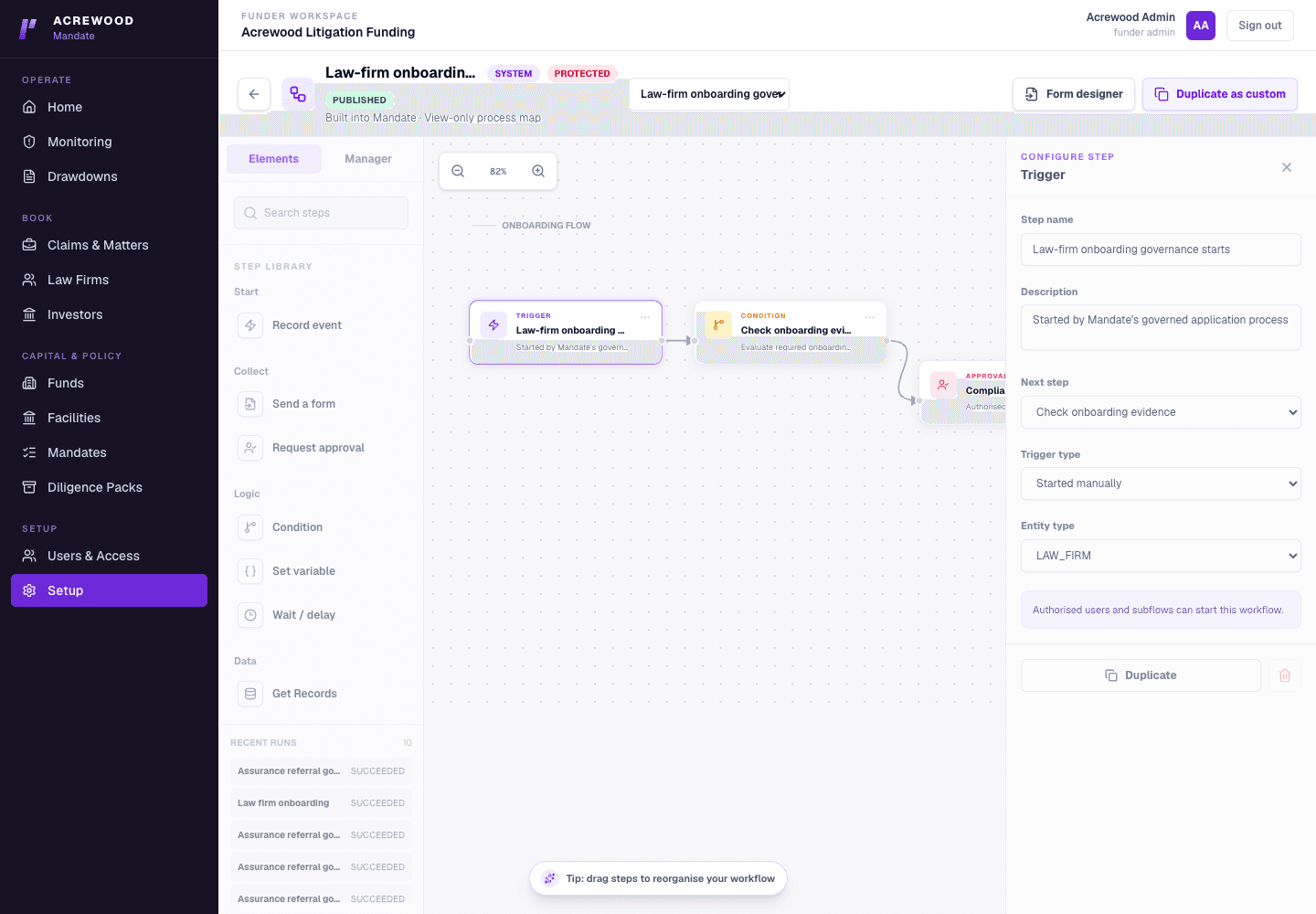
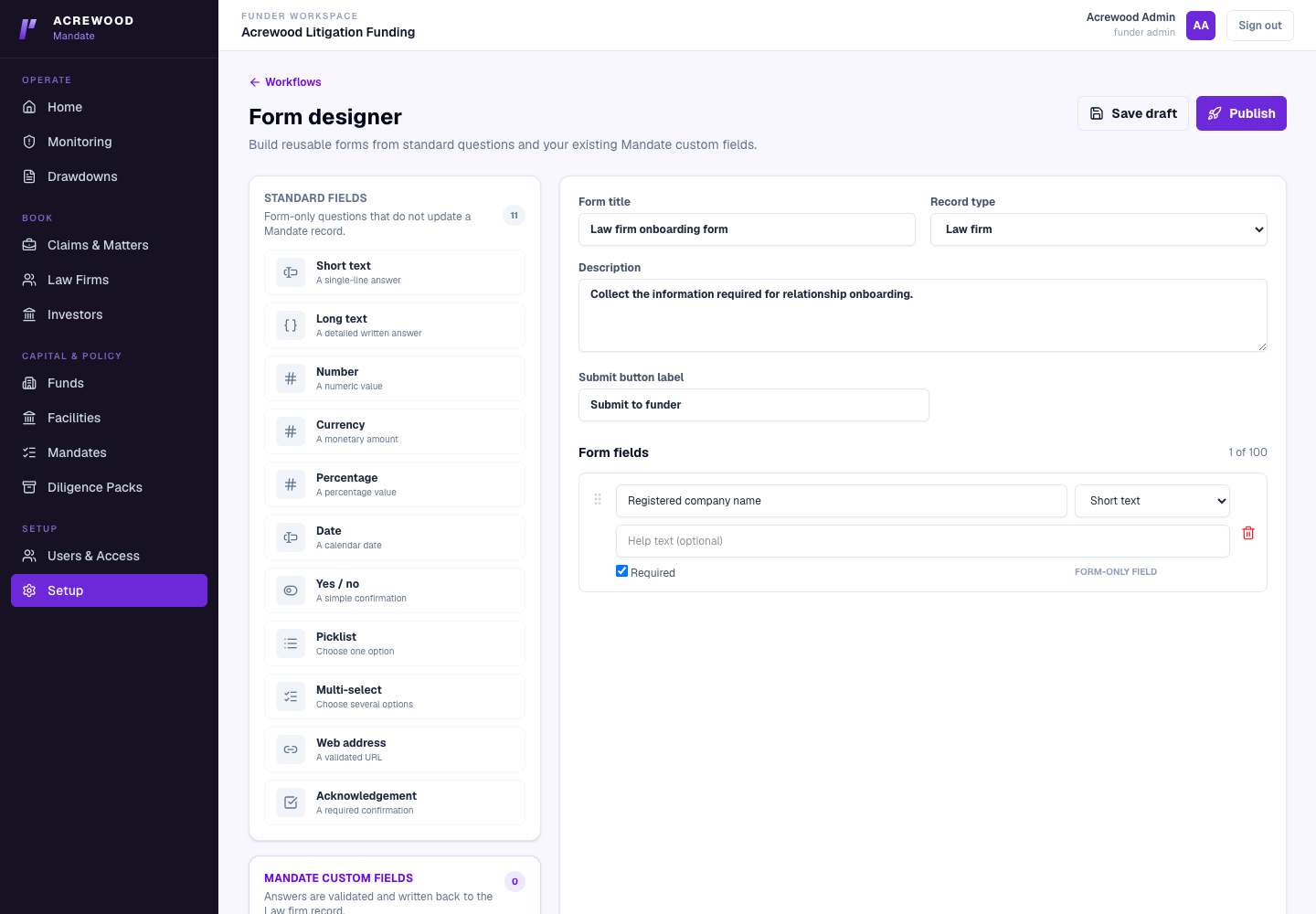
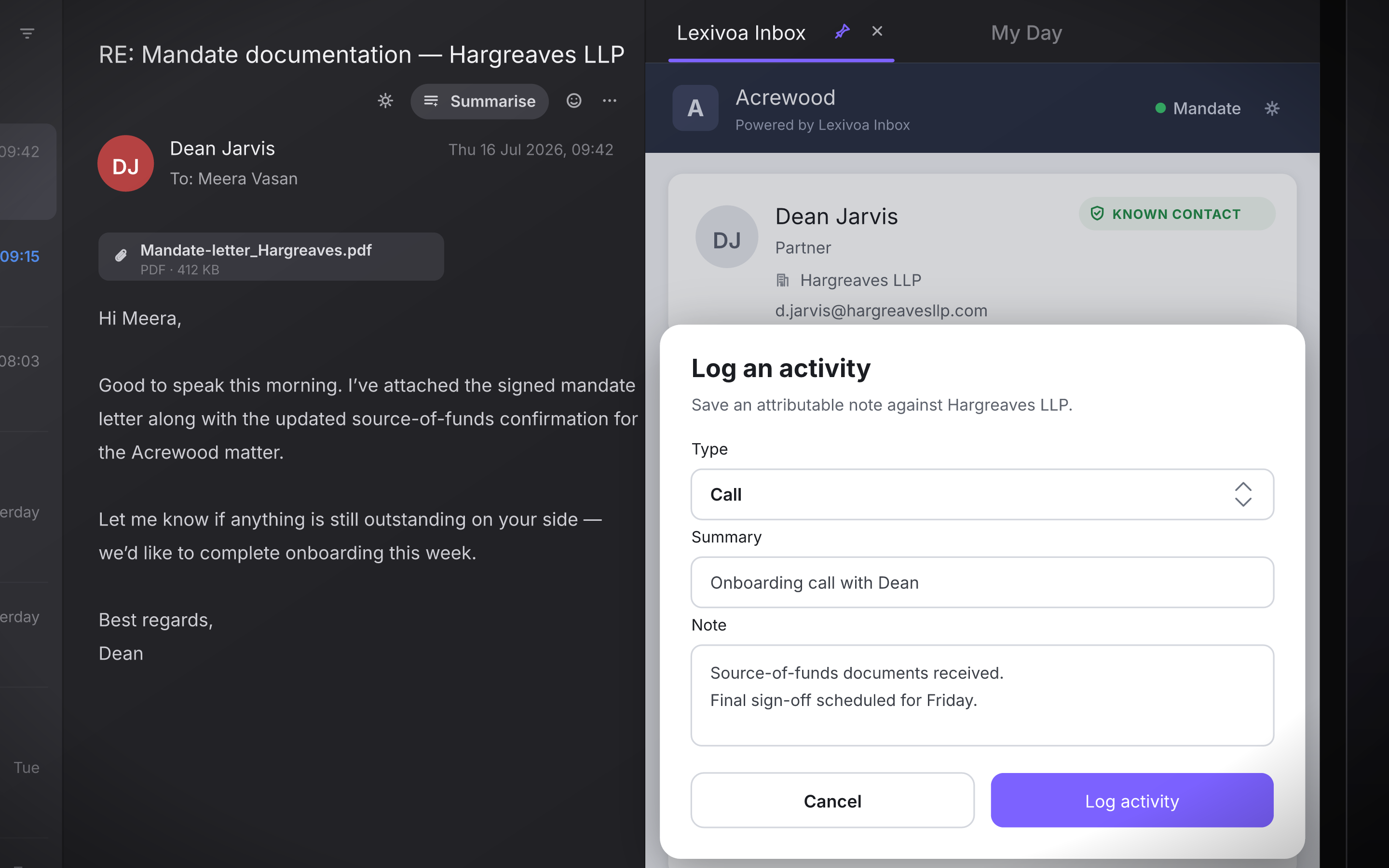
Within Lexivoa, the visual workflow builder is designed to connect governed forms, record actions, approvals, reminders, activities and communications. Lexivoa Inbox provides a shared communication layer around those processes, helping correspondence remain connected to the relevant records and operational context.
The intention is not to create automation for its own sake. It is to help funders design clearer, more consistent journeys while retaining human oversight where judgement and relationships matter.
Better experience can strengthen governance
CX and governance are sometimes presented as competing priorities. In practice, carefully designed journeys can support both.
A structured journey can provide:
- consistent treatment of participants
- clear ownership of each action
- traceable requests and responses
- fewer missed handoffs
- controlled approval points
- better visibility of delays and exceptions
- a more complete record of communications and decisions
This is especially relevant when operational information intersects with assurance.
An assurance finding may require additional evidence, a remediation action or a governed decision. The participant does not need to see the complexity of every internal system. They need a clear request, an appropriate way to respond and confidence that their response has been received and acted upon.
A good experience can simplify the interaction without simplifying the control.
Map the journey before automating it
Before configuring a workflow, map the journey from the participant's perspective. A collaborative whiteboard tool such as Miro can be useful, although the method matters more than the software.
For each stage, capture:
- what the law firm or LP is trying to achieve
- what information they are asked to provide
- which communications they receive
- what happens internally
- where a decision or approval is required
- who owns the next action
- how long the participant is expected to wait
- what evidence or activity must be recorded
- where uncertainty, repetition or delay occurs
It can help to separate the map into two layers. The first shows what the participant sees: forms, requests, updates, meetings and decisions. The second shows the internal activity required to deliver that experience: checks, assignments, approvals, record updates and assurance activity.
Map the experience first. Automate the process second.
Once the journey is understood, the parts that benefit from orchestration become clearer. Repetitive coordination can be automated, important controls can remain explicit, and moments requiring human judgement can be deliberately protected.
Design around relationships, not systems
The greatest risk in workflow design is reproducing an organisation's internal structure and expecting external stakeholders to navigate it.
Law firms and LPs do not need to understand which internal team owns a particular record, queue or control. They need a journey organised around their relationship and objectives.
That means designing from the outside in:
- identify the participant and the outcome they are trying to achieve
- map the information, decisions and communications required
- define the moments where human judgement is essential
- automate repetitive coordination and record keeping
- make ownership and the next action visible
- test the journey from the participant's perspective
- measure where delays, confusion and repeated requests still occur
The resulting workflow should reflect the experience the funder wants to create—not merely the systems it already operates.
A developing source of differentiation
As the litigation-funding market continues to develop, strong underwriting and disciplined governance will remain fundamental. They may not, however, be the only ways in which funders distinguish themselves.
Law firms will remember whether a funding process was clear and professionally managed. LPs will form judgements from the consistency, transparency and quality of their interactions. Internal teams will feel the difference between a relationship supported by well-designed processes and one held together through manual coordination.
The next stage of operational maturity may therefore involve a broader question:
Not only, "How should this process work?" but also, "What should it feel like to participate in it?"
For funders willing to design both, customer experience can become more than a service objective. It can become part of the operating model.